
The lifecycle report segments your ticket-buying audience by how often and how recently they have attended. It answers the question: "Who are our first-timers, our loyalists, and who have we lost?"
Go to Admin → Venues → [your venue] → Reports → Lifecycle.
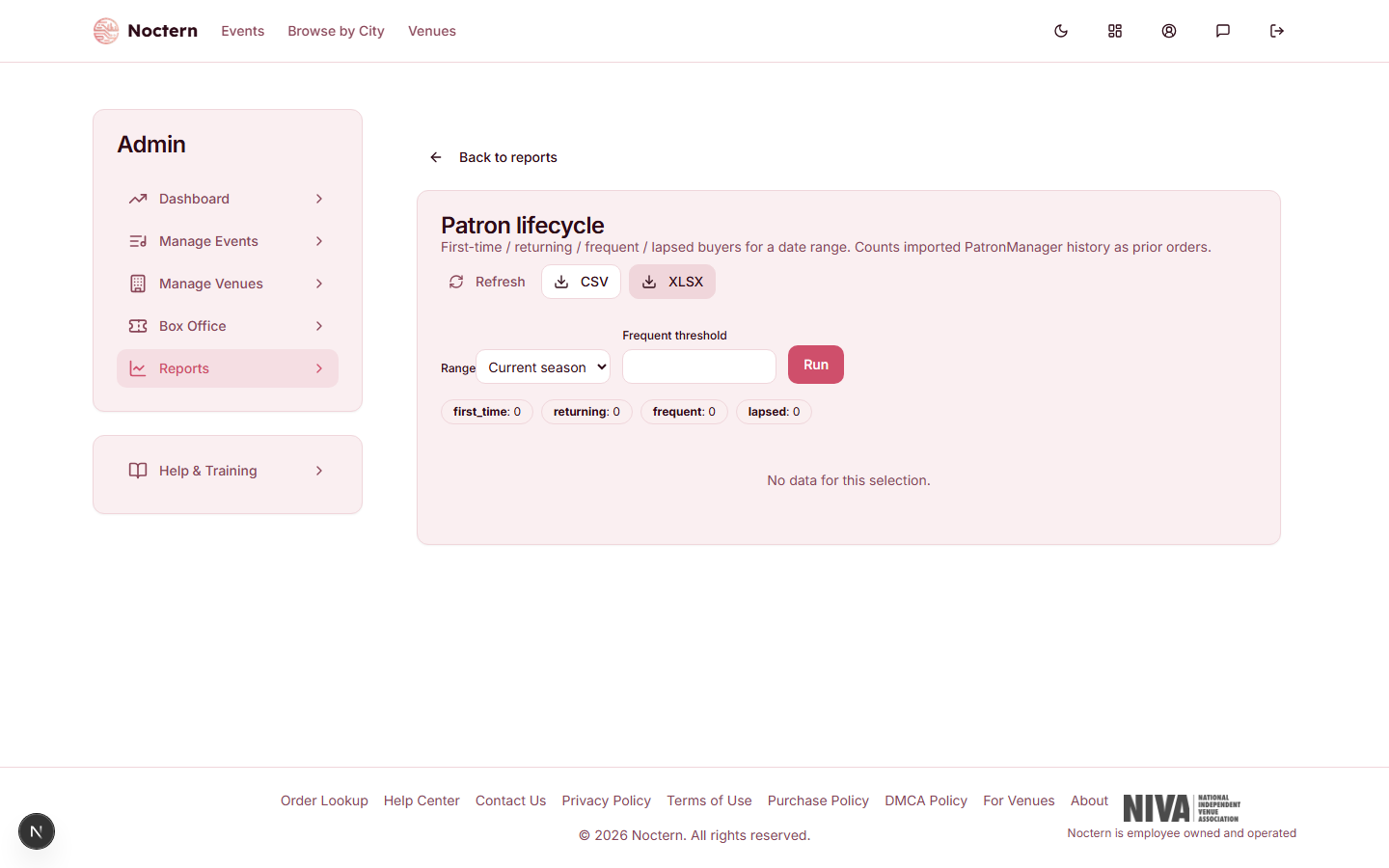
Classifications
| Tab | Definition | |---|---| | First-time | Patrons who had no order before the date range you selected and placed their first order within it | | Returning | Patrons who had a prior order before the range and ordered again within it | | Frequent | Patrons with a total lifetime order count at or above the frequent threshold (default: 3 orders) | | Lapsed | Patrons whose most recent order is older than the lapsed threshold (default: 18 months) and who placed no order in the range |
Thresholds
The "frequent" order count and "lapsed" month count are configured per venue under Admin → Venues → [your venue] → Settings → Lifecycle thresholds. Adjust these to match your audience's natural attendance cadence — a venue with mostly annual subscribers may want a lower frequent threshold than a weekly concert series.
When there's no data yet
Unlike cross-attendance, lifecycle counts orders, not completed performances — an advance sale for a future show is already a real order and counts immediately. This tile only disappears from the Reports hub for a venue with zero orders ever recorded (no native purchases, no imported history).
Historical orders
Imported historical orders count as prior orders in the lifecycle calculation. A patron imported with a prior ticket record is classified as Returning or Frequent, not First-time, which gives you an accurate picture of your established audience on day one.
Per-patron rows
Each tab shows a list of matching patrons with:
- Name and email
- Orders in the range
- First order date and most recent order date
- Lifetime order count
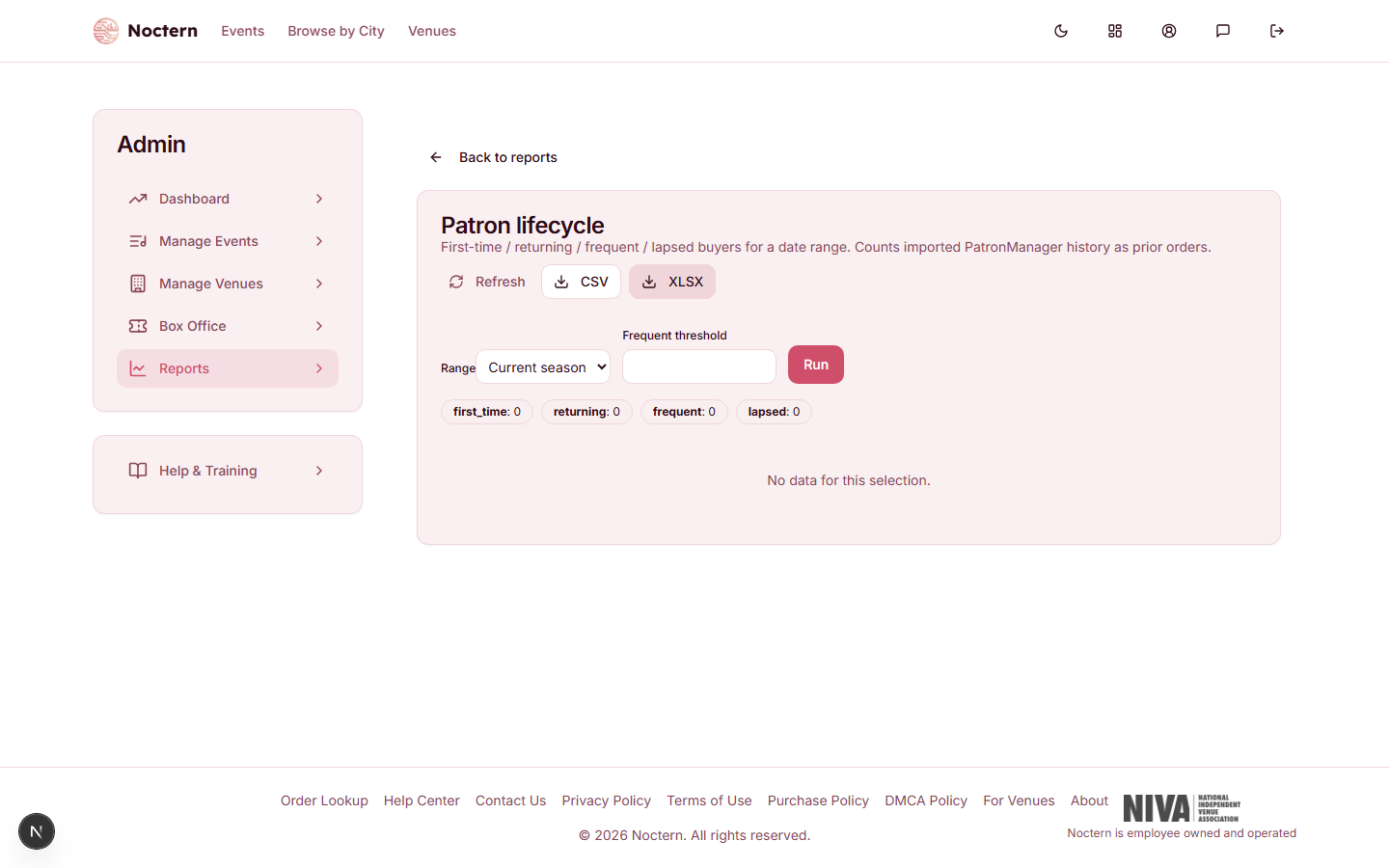
Exporting
Click Download to export the current tab's patron list to CSV or XLSX. Use the export to load targeted patrons into a re-engagement campaign or to share with your development team.
Lifecycle data is computed nightly. The freshness indicator shows the last time the underlying data was updated. Same-day purchases may not appear until the next nightly run.
Open the Lapsed tab. Sort by "Days since last order" descending to see your most deeply lapsed patrons. Export the list and use it to build a reactivation audience for a campaign.