
Report schedules let you automatically run any report on a daily, weekly, or monthly cadence and email the result as an attachment — so your team receives key metrics without logging in.
Go to Admin → Venues → [your venue] → Reports → Schedules.
The schedules list
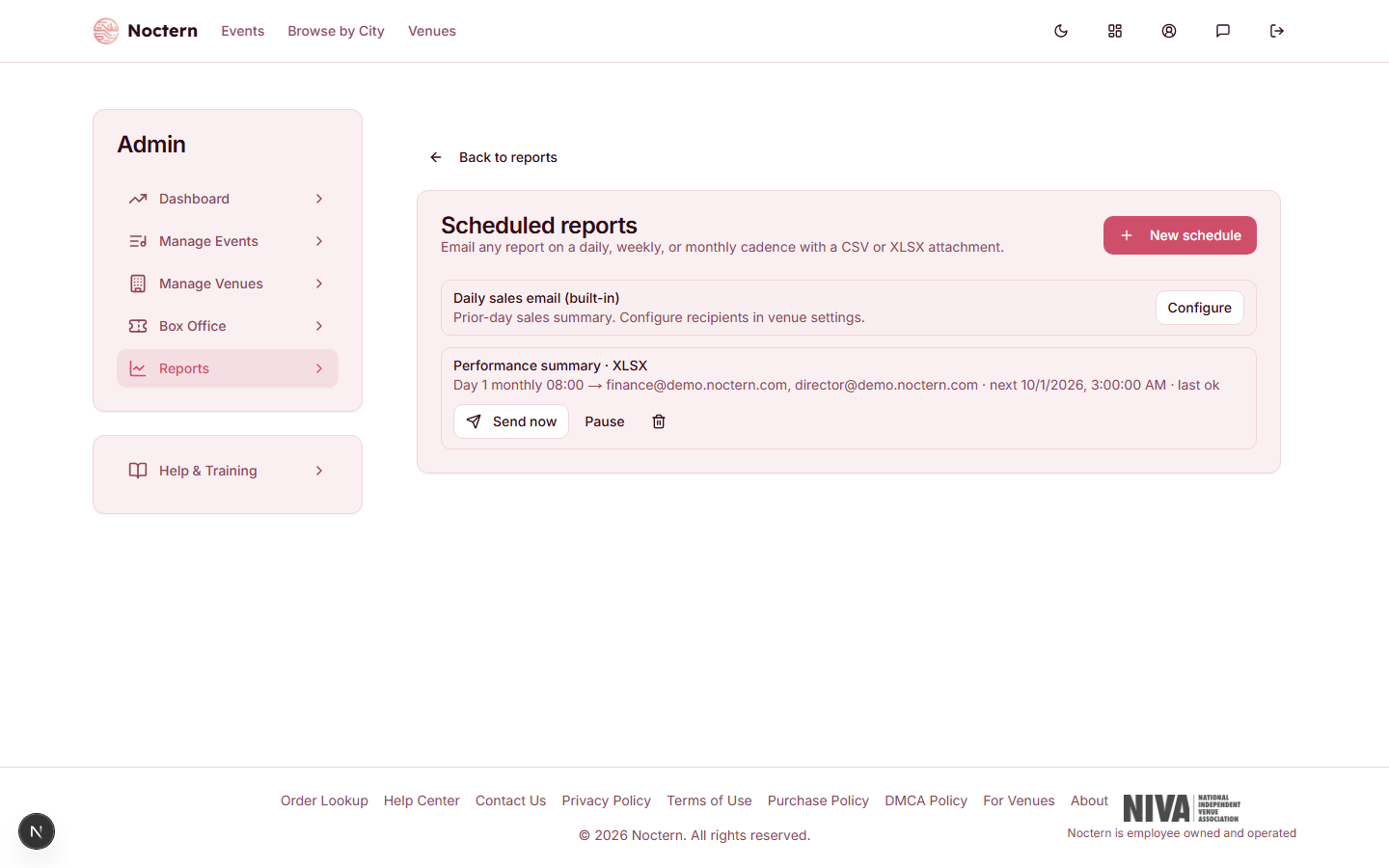
Each row in the list shows:
- Report — which report type this schedule runs
- Cadence — daily, weekly, or monthly
- Last run — when it last ran and whether it succeeded or failed
- Next run — the upcoming scheduled send time
- Recipients — how many email addresses receive each send
The built-in daily sales email is shown as a read-only row. To change its recipients, go to Admin → Venues → [your venue] → Settings → Daily sales report recipients.
Creating a schedule
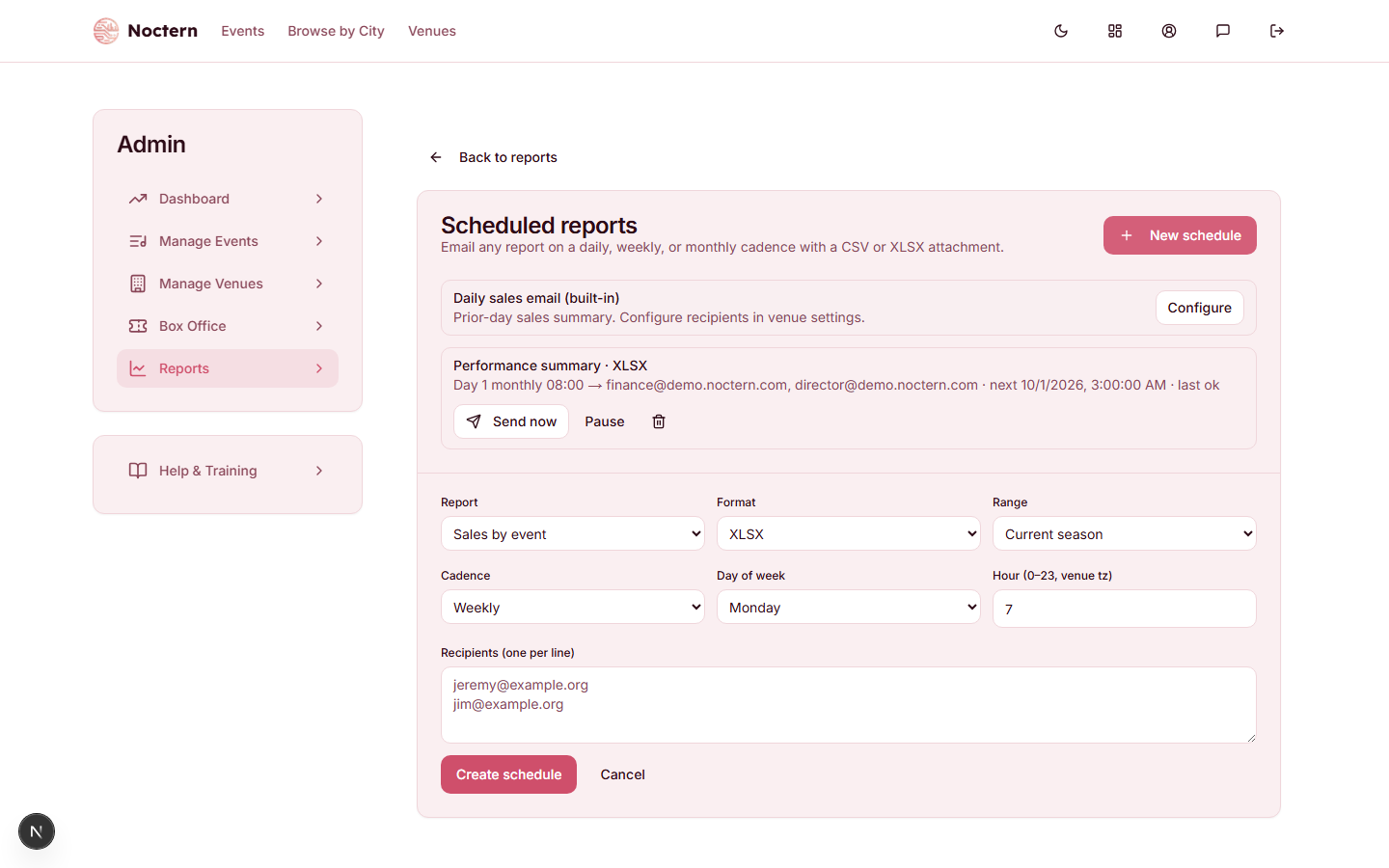
Click New schedule.
Pick a Report from the dropdown — any report available in the reports hub.
Configure the report's Parameters (for example, relative date ranges like "Last 7 days," "Prior month," or "Current season").
Choose a Cadence: daily, weekly (pick a day of the week), or monthly (pick a day of the month and an hour).
Choose the File format: PDF, CSV, or XLSX (availability varies by report).
Enter up to 10 recipient email addresses, one per line.
Click Save.
Sending immediately
Use the Send now button on any schedule to run it immediately and email the attachment to all recipients without waiting for the next cadence. This is rate-limited to 3 immediate sends per hour per venue.
Schedule run times
Cadences run in the venue's configured timezone:
- Daily — at 6:00 AM venue time each morning
- Weekly — on the selected day of the week at 6:00 AM
- Monthly — on the selected day of the month at the hour you choose
Recipient addresses are not marketing-consent-gated — they are assumed to be internal staff addresses. Do not add patron email addresses to report schedules.
Report attachments are capped at 10 MB. If a report exceeds this limit, the email contains a "View online" link instead of an attachment. Narrow the date range or filter the report to reduce size.
Use relative date ranges like "Current season" or "Prior month" rather than fixed dates so the schedule stays useful over time without needing to be updated.